Welcome to the Spring 2018 edition of the MADRS Newsletter
Personally, I just don’t know where the time goes. Here I am putting together another edition of the Newsletter and it’s the first edition in another new year. In 2017, the MADRS grey team removed 1447 grey squirrels from our area. As always, I’d like to stress that this is not a side of red conservation that is taken lightly but is absolutely necessary to ensure the survival of the reds. This grey control work has really paid off with an increase in red sightings from both our ‘normal’ areas, but encouragingly, in some new areas too. Read more>>

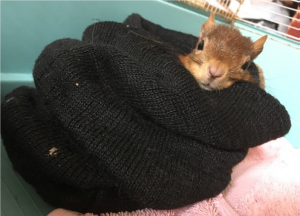 The future of Red Squirrels in the Penrith area was given a boost in late November with the announcement that the Lowther Estate is to embark on one of the largest new commercial woodland creation schemes in England for the last twenty five years, and Wesley Squirrel gets “Reet back amang it” as he is finally set free!
  Our next issue will be our Annual Review in February but already it’s been a remarkable year. The number of greys reported culled this year has exceeded last year’s total and currently stands at 3299 – a testament to the amazing and effective work our volunteers, contractors and landowners are doing to protect our reds.
 In this edition of Red Squirrel News, get an update on the pine marten reinforcement and find out about how they have become frequent visitors to our squirrel feeders, read the latest on the deadly squirrel pox virus from north Wales, plus much more squirrel-related news.
 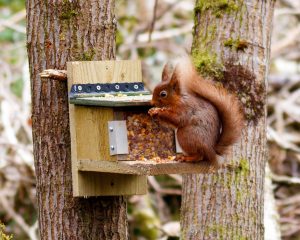 Airgun enthusiast and BASC member JASON BRAITHWAITE reports on an exciting and successful red squirrel conservation project taking place in the woodlands of Western Lakeland. Read the full article
 As we approach the end of this year, we are starting to focus on the future and you will see that we are still busy across a range of activities. We are:
 Leprosy was first diagnosed in red squirrels on the Isle of Wight in 2015. Visual signs to look for are unusual ear and skin lesions, although animals with the leprosy bacteria do not always have symptoms. Helen collected ear samples during routine post-mortem examinations she did on 93 squirrels found dead from all around the Island. Deaths due to natural or unknown causes accounted for 33% of cases and 67% ere as a direct result of human activity, especially road traffic. Helen took the samples to Moredun Research Institute and, after training, tested them for leprosy. Only one out of the samples proved positive. The affected squirrel was an adult male that was a road traffic accident in 2016. There were no visible signs of leprosy. It would be interesting to know if there has ever been a leprosy hospital on the Isle of Wight. Are there any historians out there? In the past we have had two confirmed cases of leprosy in squirrels on the Isle of Wight, one had died in 2004 and the second in 2011. The infection is at a low level in the population and has almost certainly been present on the island – and the rest of the country – for a long time.